(Click on photos for larger versions)
Recently an article about the 13-million-dollar renovation of the Methodist church at the northeast corner of 12th Street and Central Avenue in Indianapolis triggered a cascade of memories from my early childhood. Here is a
link to photos of the restoration efforts.
My mother and two of her three siblings were born about half a block from that church, and her parents and my great-grandparents lived in that Italianate mansion at 1121 Central; they also owned the house next door, at 1127. Those houses were built during the Civil War, and were part of the Old Northside. The Romanesque church at 12th and Central was formed as a merger between two Methodist churches, and was built in 1891; that is where my parents were married.
After my father left the military, my folks rented part of the home at 1127 Central. They lived there when I was born, and stayed until I turned five.
Though we moved to a new home a few weeks after my fifth birthday, I still remember quite a bit from living on Central Avenue, as well as frequent visits until the houses were torn down in 1966, as I-65 gouged through the Old Northside.
This is a
link to a street-level panorama from Google Maps—the I-65 overpass itself is where the houses once stood. If you hold down the left mouse button and drag from left-to-right, you can see the church and how close it was to the homes. The original plans for I-65 would have taken out the church, but they were altered to preserve it and the Morris-Butler home right behind it. It turns out that Flo is related to the Morris family, and her great-grandparents lived behind us on Park, in another home demolished for the interstate.
When my father first joined the Indianapolis Police Department, he didn’t own a car, and the city did not allow officers to use a patrol car after work in those days. I remember running out to meet him when I saw him step off the bus. I also remember the lines and the feel of the blue Buick, our first car, purchased when we lived on Central.
My father was once called to help a little girl who was being savagely attacked by several dogs in her backyard. He rescued her and took her to the hospital, and after discovering he had the same blood type, donated to help save her life, then went straight back to work. On hearing of this, reporters were sent out to do a story on my dad, and took a photo of him with me and my Cocker Spaniel puppy Jet, in the back yard at Central.
The apartment we lived in was rather simple and plain, but comfortable. Both houses were subdivided decades before into multiple apartments. I remember Eileen Goldstein, a friend of my mother’s, who lived in one of those apartments with her husband. There also was a nice elderly lady who never left her apartment—she was very heavy and could not get about well. She would talk to me as I played on the stairways in our house. I remember that it took a half-dozen or so young firefighters to carry her body down the narrow stairwell when she died.
While 1127 was a huge wood-frame house, the mansion at 1121 was a solid, imposing brick and stone structure—the house was long, and much larger than it appeared from the street. I would like to study the records of ownership—rumor was that it was built by a physician. My mother told me a story when I was young, that they were replacing some wall paper in a room, and found where someone had written a date in 1865 on one of the walls. (Scroll to the end to find an obit for the original owner)
These houses were built before gas, electricity and indoor plumbing were established or reached the neighborhood, and thus had to be renovated each time a new utility became available. Indoor bathrooms were constructed as additions on the sides of the homes; there were still carriage houses in the alley. Dark, chained and locked, the carriage houses were mysterious and inviting. I remember straining to get peeks through the doors and windows, seeing shadows of perhaps remnants of buggies and what seemed to be tools or farming equipment, and Victorian-era oddities a child couldn’t quite catalog in his memory. Had I been a few years older, I would have found a way in and explored thoroughly.
One tale I do not myself remember: I was an infant and my father had just started on the police department—my mother awoke in the middle of the night to fix me a bottle. She heard groaning coming from the alley, and calls for help. She did not want to wake my father, who had just gotten to sleep after a long shift, so she ignored the cries. The next morning, my folks saw police and onlookers crowded into the alley behind the house. About a block away, a man had been caught cheating on his pregnant wife. The couple had a fight, and she stabbed him with a butcher knife. He staggered down the alley crying out for help, and died behind our house. My dad was teased for some time for sleeping through that one.
Click here for an update!
The house at 1121 thoroughly retained the feel of the Victorian era. Old, dark patterned carpeting and ornate furniture. My great-grandparent’s apartment was on the ground floor, while my grandparents took the upstairs; there were also apartments on the other side of the building. The first piano I ever plunked on was in my great-grandparent’s apartment. I am not certain, but I believe they purchased the homes around 1910. A dark, imposing curved stairway led upstairs to my grandparent’s digs. Numerous outdated relics still adorned the apartments. Fixtures for gas lighting that were no longer used, as well as an archaic louvered grill covered with asbestos—a gas fireplace, long out of use. The first electric lighting, installed in the mid 1870s, featured push-button wall switches—two black buttons with white tips—as you pushed one in, the other came out—absolutely fascinating to a toddler—I must have pushed those hundreds of times. Modern switches were installed, but the older ones for the most part remained, no longer functioning.
One of the most intriguing features to me was the tall, arched windows. On the second floor, in the grandparent’s living room, they had latches and hinges and once swung open, so one could walk out onto a wide stone balcony where you could oversee Central Avenue. I begged many times for them to open them and let me out—but they had not been opened for a generation or more. I would peer out and wonder what it was once like, to chat on this patio and feel the breeze and listen to the sounds of the city from a height. My imagination could easily take me back to the last days of the Civil War, and what one might have seen from that balcony.
From front to back, the building seemed to change personality several times. At one point, the hallway narrowed, and there was a small desk next to more arched, inoperable windows that looked into the house where I lived, next door. The corridor quickly widened again to a dining room with a formal dinner table, and a row of narrow closet doors, locked and forbidden to open; of course, I tried.
I loved my grandmother’s kitchen—it had such an unusual feel to it—I’ve never seen a kitchen quite like it since. A series of old but well-kept, odd-shaped kitchen devices that never seemed to be used—food was cooked on a conventional stove, but the other appliances were objects of fascination. Rounded lids and corners, strange gauges or meters, thick old fiber-wrapped electrical cords. I’m sure their actual functions were quite mundane, but when I was little, they were Victorian Steam-punk, elaborate in construct and purpose, to my imagination. I wish I had photographs documenting each room of those houses.
To the right in the kitchen was an old wooden door, nothing as elaborate as those in the front of the house. It opened to another stairwell, a steep, narrow, straight-shot to the ground-level back door, and the shared backyards. Worn wooden steps and plain, tall slat walls, and I remember a touch of vertigo because the stairway was steep unlike the graceful curve of the front stairs.
Out the back door, to my left as I left the house, were the classic slanted doors to the cellar. It was a rare treat when my grandmother unlocked those doors, and rarer still when I was allowed to descend into the dark, spider-webbed recesses of this house. I can still remember the earthy smells of that cellar, the ancient black topsoil from the forest that once stood here. With modern homes, the rich humus is all bulldozed away, down to hard clay; but not in the days these homes were built.
The cellar was another world entirely, the stuff of dreams and imagination. Seemingly ancient tools and farm implements hung on the walls and were scattered on workbenches. Storage dating from pioneer days. A rack of wooden shelves where my grandmother stored jar after jar of homemade jellies and jams, made from grapes grown on the arbors between the two houses. Underneath the lids, the jars were sealed with paraffin; a few jams were gritty from undissolved sugar, but still tasty. I can still remember the scent of that cellar.
Out back, facing the alley and to my right, a row of trees served as a property barrier. The branches of a tall weeping willow formed an overarching tent that kept out the sun, and left plenty of room for a child to hide and watch everything going on. At least I believed, no one knew where I was when I hid under that tree.
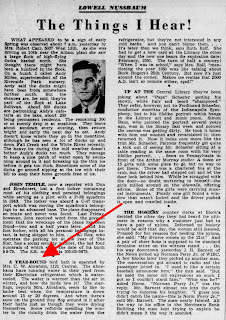
There once stood an imposing birdbath in that backyard. No longer used for birds, in its center was an enormous geode—it looked to me like a giant cauliflower, or perhaps the crystallized brain of a titan. I was convinced that it possessed some sort of magical powers, though precisely what they might be, I never quite figured out. I still remember peering into the geode, in the blue and black of night, and watching the moonlight sparkle and dance in the clumpy crystals. (I've added a newspaper mention of this birdbath below.)
I remember the old-style radio my mother kept in the kitchen; tan leather on the front and sides, a curved, rounded top with a large dial and a red pin or pointer that moved left and right to the different station frequencies under the curved glass. Those cool, rectangular buttons that were mechanical presets—each one you would push would cause the red line to zip across the dial to one station or another—there was a “crunch” sensation whenever you pushed one of those buttons. Mom listened to her radio soap operas on this box; they lasted 15 minutes each, while she was cleaning and cooking, and I followed her from room to room with favorite toys.
The more I reminisce, the more images and instances come bubbling up. My father trying to teach my mother how to handle a gun, just in case… the time an aunt and uncle dropped off one of their sickly children… for a year. I had a brother of sorts for a while. In the middle of the night, Christmas eve, finding my toys under the tree, when I was about four—woke my folks up with the noise I made playing. Before the house was razed, we rescued armloads of books from an attic a family of four could have lived in comfortably. From pulp fiction to
The Critique of Pure Reason, by Immanuel Kant, also a 2nd or 3rd edition of the collected poetry of Lord Byron.
The clatter of a wooden screen door… the city sounds and summer breezes, the moods, memories and histories of a century that included my first five years… now just an embankment supporting concrete, home only to the ceaseless drone of interstate traffic.
Other photos of 11th and Central, and Abraham family businesses.
(From The Indianapolis Star, Wed. Feb 13, 1946)
The Original Owner - Indpls. News, Sept. 26, 1901
An interesting tenant (Indpls. Star April 22, 1946)
C.W. Abraham
Nellie Correll Abraham